Showing posts with label Portugal. Show all posts

Wednesday, September 12, 2012

Betty by the Numbers: Touring the Rest of the World

Okay, let’s get this out of the way first:  in Tangled Autumn (1971), Sappha Devenish and Rolf van Duyren visit Uithuizen in the Netherlands, Betty von Susie’s family’s ancestral homeland.  That’s right:  Uithuizen!  In the Netherlands!  Where Betty von Susie’s ancestors lived!  They look around Menkemaborg Castle in UITHUIZEN.  Uithuizen, Uithuizen, Uithuizen.

Moving, one hopes, right along, I am pleased to note that Betty Lulu guessed correctly that the #2 most-toured country in The Canon is England, whether or not combined with Scotland to form (most of) the United Kingdom.  Others nominated a host of worthy candidates, all shown in my Bettyworld-view:


Or, put another way:


The Netherlands
81
Madeira
4
Belgium
1
Poland
1
England
43
Canary Islands
2
Czechoslovakia
1
Sweden
1
Scotland
8
Greece
2
Denmark
1
Switzerland
1
Norway
6
Italy
2
France
1


Portugal
5
Spain
2
Hungary
1


Germany
4
Austria
1
Malta
1


Note that the pie is sorted first by number of visits, and then in vaguely chronological order (that’s right, France, yes, FRANCE, is the first one-visit-only country to get a Betty visit), while the table is rigorously alphabetical.

So we’ve looked around the Netherlands with Emma Serena Cresswell-Creswell, and we’ve toured England and Scotland with Katrina Philomena Dowling-Downing.  If you’d care to join me, we might now take a jaunt around other European beauty spots with Francesca Matilda Culpepper-Crump.  And, oh, if only Sister Wise had been more fair and less airy about duty hours, we’d have had a peek at Africa!    Honestly, if I ever make it to Alexandria (the one in Egypt, not the one right down the parkway in Virginia), I am so totally bringing my copy of Never While the Grass Grows (1978) and, whilst standing atop the Qaitbey Fort, opening the pages wide and rotating 360 degrees to give Octavia a good, long look around.*


Alexandria – not the Qaitbey Fort, but seems worth a visit...


But for now I shall compose myself in patience, and enjoy the myriad delights of...  Norway!  Norway is Betty’s number-four most-toured country, with four visitors between 1979 and 1981, one in 1986, and a final sixth visitor in 1997.  Those six tourists comprise 4% of the 135 Neels heroines, and begin with Becky Saunders in The Promise of Happiness (a/k/a, if you’re on board with the Founding Bettys, Becky and the Baron – the Hot, Hot Baron), who trots around Trondheim, when not seeing to the worldly comforts of her imperious but lovable patient, and expands her horizons through visits to the Folk Museum, cathedral and other points of interest.   Plus popping into the shops to achieve the very gradual expansion of her very scanty wardrobe.

If I’ve got the geography right (not offering odds on that), Annis Brown makes it furthest north when she moves in with Dr. Jake van Germert and the motley crew staffing the Spitsbergen radio station, way up above the Arctic Circle, to be entranced by the Midnight Sun’s Magic (1979).  Spitsbergen is also, I believe, the geographically farthest any heroine gets from home, whether home is the West Country or the Highlands or London.  Back on Norway’s mainland, Tromso and Bergen get the most visitors; Oslo, the capital, gets just one (Two Weeks to Remember, 1986).  Betty sticks mainly to the coastline – as most Norwegians do, I suspect.  It’s not like you’re going to eat really well off the local flora and fauna during a rough winter inland, after all; and besides, Norway is one of those long, thin countries that boasts a strong coastline-to-inland ratio.

 Northern Lights over Spitsbergen, or Spitzbergen

Portugal is next in our hit parade, with five tourists, or 4% of the books, one in 1974 when we Cruise to a Wedding, and the remainder in the early 80s.  That same cruise also takes us on our first of four visits to Madeira, which ties with Germany for the sixth-most-popular tourist destination in Neelsland, with 3% of heroines each.  Our Madeira visits are a bit more spread out chronologically, with that first 1974 visit followed by trips in 1977, 1980 and 1994.  Madeira is an autonomous region of Portugal, but since that autonomy includes its own legislature and its own flag, I’m counting it as a separate country.  If you prefer otherwise, Portugal squeaks in just ahead of Scotland, which becomes our fourth most-toured country – unless you count Scotland as part of the UK, in which case Portugal is third and Norway fourth.  Gracious, you’re picky, aren’t you?

Anyway, Loveday Pearce (CtaW) and Annis Fothergill of All Else Confusion (1982) both visit Lisbon, which is roughly southwestern, coastal Portugal.  And that is the area for all our other explorations as well – the Algarve (southernmost province) and the Lisbon region, with named towns to explore including Sintra, Cascais, Estoril, Ponte de Piedade, Sagres, Monchique, Silves and Caldas.  If you’re planning a visit, I suggest a chat with Eugenia Smith.  Before her Heidelberg Wedding (1984), Eugenia does a good bit of touring in Portugal, with the help of the knowledgeable Gerard Grenfell.


Henry the Navigator – you know why.


In Madeira, Funchal is a must (probably literally; it’s not a large island), with each of our four heroines visiting.  You can borrow or rent a car in that small city, and then drive out of town through the winding mountain roads and along the glorious coast to Camara de Lobos and all the other semi-tropical beauty spots.  Madeira is my favorite Betty-destination, and writing this has brought it back up on my must-visit-someday list.


None of the pictures of Madeira I found were as brilliant with colorful flowers as I thought they would be.  Still, rather attractive, don’t you think?


So Germany, tied for sixth.  Of course there’s Heidelberg and its castle, for Eugenia and Gerard’s eventual wedding.  Before that, Alethea Thomas van Diederijk finds time to explore Hamburg By Sun and Candlelight (but mostly sun – just trying to be clever) (1979).  We also have two visits that are more like drive-bys:  Cordelia Gibson – okay, she’s a sail-by – hits Altotting on her way down the Danube (Magic in Vienna, 1985), and Beatrice Browning and her fake-fiancé Oliver visit Zons and Cologne in 1989’s Hilltop Tryst.  Be warned:  my notes for the latter include, “but mostly just shopping,” and “lousy European travelogues.”

 Zons!

 Now, tied for seventh, with two visits each (1.5% of heroines):  the Canary Islands (officially part of Spain?), Greece, Italy and Spain.  I think the most memorable of these has got to be Katrina and Lucius’s fake-engagement tour of Greece (Roses and Champagne, 1983), which included not only Athens, Piraeus, Sounion, Lavrion, the Mesogeia plain, Marathon Bay, Kophisia, Thebes, Levadia, Hosias Loukas, and Delphi, but also an earthquake!


Some of the same pictures came up when I searched on “Canary Islands” as when I searched on “Madeira.”  But they are different places – probably both worth visiting.


Then we have our ten eighth-place destinations:  Austria, Belgium (!), Czechoslovakia, Denmark, France, Hungary, Malta, Poland, Sweden and Switzerland.  Much as I enjoy all the fiacre-riding and torte-eating that Cordelia does in Venice, and adore though I do Sarah Ann’s dancing on the Avignon bridge (Fate is Remarkable, 1970), surely you will agree that Iron-Curtain Poland is Betty’s pièce de résistance amongst this group.  Honest to goodness, Isobel, Thomas and Nanny’s lighthearted-on-the-outside traipses through Gdansk, Sopot and Oliwa must be strong contenders for Best Betty Travel Scenes Ever (Never Say Goodbye, 1983).


Not a part of the Sopot Music Festival that Isobel and Nanny attended.
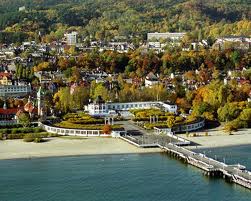


I believe they didn’t get to see the city from this perspective – just above the Baltic – either, but clearly they could have had an enjoyable look around Sopot.


Finally, let us note that ten of the Novels Neels contain no tourist tips of any real significance.  That’s actually just 7% of the books, but if Damsel in Green and Roses Have Thorns and Henrietta’s Own Castle weren’t three of them I’d be tempted to demand a refund.

Unlike Georgina, Sarah and Henrietta, Beatrice Browning manages to tour five countries (England (Cornwall), the Netherlands, Germany, Denmark and Belgium) in the course of one short novel.  Sadly, while her visit to Polperro inspires a desire to emulate her, her European travel, as noted above, is heavy on the shopping and lousy on the local color.  Cordelia Gibson (Hungary, Germany, Slovakia and Austria) and Octavia Lock (Italy, Greece, Malta and the Netherlands) each hit four, both helped by cruise ships.  Five heroines tour three countries each, 25 tour two, and 92 see a single country (Netherlands, Netherlands, Netherlands...).  Anyone interested in sharing your own favorite itinerary?


*Please forgive me if Madeira and the Canary Islands are African.  Given their political affiliations with Portugal and Spain, I’m calling them European, regardless of latitude.  Or do islands not get continental status, and that’s why all those Britons insist they’re not Europeans?

Monday, March 15, 2010

Grasp a Nettle--1977

Grasp a Nettle is/was one of Betty Debbie's least favorite books and when we began searching out websites for what was to become the awesomest blog ever (this one. I mean this one.) we stumbled across this site--a great resource for cross-over characters and I think the Betty bio linked to in our header also came from here. But there it was. Grasp a Nettle was the author's most favorite Neels. How could this be? So when I re-read it I was looking for the occasional flashes of brilliance that would rise the book out of the swamp of pedestrian brangling.

Jenny Wren--a name, no matter how innocently used, that manages to remind me of Kevin Bacon's character in Footloose. She is 25 and a nurse at Queen's Hospital in the East End of London. She's got a pretty face, is average height and nicely rounded. She's also got red hair--an Outlier for sure. She comes home on holidays to help out at the family's stately home. Say what? That's right. They're pretty well off but Jenny is the independent type that prefers not to sponge off the estate. Aunt Bess orders everybody about and Jenny sells tickets to tourists in the lobby.

Professor Eduard van Draak te Solendijk is a mouthful. Don't fret yourself, he almost always goes by van Draak. He is a surgeon and Dutch of all things! He's near forty or almost forty or approaching forty--you never really find out but the point is that he is tall with iron-grey hair and has a "masterful nose" (Which, really, on a man would be quite charming but she's stuck if their daughter inherits it. The van Draak te Solendijk's don't strike me as the kind to go for plastic surgery.)

Dry Ground--Dimworth:
Jenny has been spending a lot of time--off camera, so to speak--telling the oldest son of the neighboring estate (read: heir) that she doesn't have any interest in marrying him. He's a sedate driver, entirely 'suitable' (beware that sobriquet), has a little tummy bulge and his neat penmanship is a moral indictment of his utterly placid nature--and unlike the te Solendijk's of this world, Tubby Toby really is placid. Still, he's like a LIMPET and she can't shake him. If only she could meet someone she has chemistry with!
Aunt Bess has a very handy subdural haematoma--if ever pooling blood can be termed handy. Jenny has to throw her job over (Aunt Bess doesn't thank her, not once!) and come nurse Aunt Bess. Enter the smorgasbord of Dutch deliciousness.
The Good Doctor and and Jenny hit sparks off immediately. He is a teensy bit stiff-rumped, his penmanship is probably nigh unreadable, he drives like a demon and he makes bets with Aunt Bess just to get her to lie still. Of course, in the face of all that self-contained bo-dacity, she has to stick her tongue out and be pert and flippant. They're perfect for each other. And at the heart of things they both know it--else why the hugely flirtatious fisticuffs?
At one point he tells her that he isn't interested in her (Proverbs 16:18) and she asks what on earth his ideal woman would look like? (And if that's not asking for a snub, I don't know what is.) He answers: Tall, calm, sweet-tempered--with good looks, of course; fair hair, blue eyes, a pleasant voice.
Oh, well, if it's a blond you want...
Margaret is Jenny's cousin's widow and mother of the heir to Dimworth. She makes her indolent way down to the stately home from time to time to strike interesting poses and avoid work. Her son the baron is just 6-years-old and his mother is described as "beautiful, languid and not particularly maternal." Later, she reminds Jenny of a "Botticelli angel". That's when I remembered something that bothered me about Botticelli (Humanities nerd alert) when I visited the Uffizi a few years ago (sandwiched neatly between weaning one baby and having another). This is what I wrote in my journal: I finally 'got' Botticelli's Venus ...live, in a huge frame I see a delicacy and wistfulness that is touching. I think he used the same model for Madonna and Child and her similar expression [appears there as] a vapid disinterestedness that is frankly inappropriate. Meet the two faces of Margaret. Her dog and pony show might be attractive to a man but as a parent she can barely summon up the requisite human emotions to make Oliver matter more or less than a stray puppy.
The flip and pert dynamic of Jenny and Eduard becomes interlarded with jealousy and perturbation (which word I hope you're reading per-turb-a-tion).
While at Dimworth, a clock tower stair collapses under the crushing weight of fleeting opportunities and pigheaded British lasses. Eduard rescues Fair Jenny from the top of it by insulting her pluck and illustrious ancestors. He most likely confuses her jungle-cat leap at his jugular with a clench-teethed jump to safety. Anyway she's down and safe and still prickly with him, otherwise this would have been a very short book one way or another.
As a piece of restorative medicine, Aunt Bess makes plans for a cruise. Oh, I feel faint. A slight headache coming on. A run over to lovely Corfu would be just the...Oh yes, back to Aunt Bess. She is a steamroller wrapped in purple velvet--getting her way in a not entirely charming manner. Dr. Hunky says to Jenny, "Your job?" British lass replies, "None of your business." Hunky doctor counters, "It could be my business..." The proper response to this always ought to be, "My ring finger is size four. I like heirloom sapphires."

Briny Deep: Cruise near Portugal
But she thinks that by "It could be my business" he must mean Margaret because, after all, he did say he had a thing for cardboard blonds...
On ship Jenny has a lot of interested men wanting to hang about which is not important at all but it does something for my female ego to know that more than Tubby Toby (who really just needs to find himself a frowzy blond willing to have six kids in quick succession) likes her.
The Good Doctor shows up--which is much harder to do causally than you might think--and joins the ship for a few days. He has flown his own plane out to Portugal--a recipe for doom if you are an American country and western singer but safe enough for a Dutch doctor, I suppose. They have some lashings of cream flirtatiousness (he insults her future children, she implies that he is old, he notices she is frightened, she calls him odious) and to top it off I give you a fabulous dawning realization:
"...I just want to be independent." As she uttered the words, the niggle exploded into amazing solid fact; she had no wish to be independent, it was the last thing she wanted to be...
Beware the Exploding Niggle! It sounds like a very nasty case of Ebola...

Boggy Marshes: Kasteel te Solendijk (Holland)
Figuring out that she is head over clogs in love with him has changed things. Gone is the flippant, laughing remark. Here to stay is Jenny of the wounded ego and baleful expression. Back in England they make plans to go to Holland (because a recently ill old woman needs travel and still more travel) for 'check-ups'. Margaret throws a really excellent tantrum over not being invited to come ("We're going to get married!") but Oliver, her son, gets to go because...this is the part of many British novels where the author throws up his hands and yells, "Primogeniture!" ...it makes zero sense for Oliver to spend any time away from his inheritance but Mommy's Little Plot Mover has to come along and because he's the possible heir to all of Aunt Bess' massive wealth Margaret stays mum-ish.
When they get to Eduard's red-brick pepper-pot albatross there is a little moment of real class embarrassment. Usually, hot millionaire Dutch doctor proposes marriage to plain/pretty poor British girl. It's a large leap of upward mobility for Hyacinth Jemima Beryl Darling. In Grasp a Nettle he owns a castle and doesn't charge tuppence to have his priceless William and Mary settees sat upon by primary school children eating grubby cheese sandwiches. He doesn't have the annoying vicar's wife charging for homemade jam and souvenir pencils. Jenny, when she realizes this, wants to quietly sink through the floor. And for some reason, I do too.
He quotes poetry at her: Tender handed stroke a nettle and it stings you for your pains, Grasp it like a man of mettle and it soft as silk remains.
Girlfriend needs a Hot Dutch to Dense Brit dictionary.
Aunt Bess has her tests and Jenny sight-sees some with Oliver and loses him on a canal boat. This is the same six-year-old that could absolutely be relied on to not upset Aunt Bess after her surgery and old enough to have things explained to. He's mature enough for all that but he hops onto a canal boat when her back is turned? I'm thinking that the computer chip implanted under his skin labeled Maturity Regression was inadvertently tripped.
Of course
in her moment of abject humiliation the doctor has to show up and of course she has to slip on a banana peel when she finds Regressive Oliver and get a concussion. (Right about now I'm thinking of all those men on the cruise ship--happy to have the memory of attraction and competence to warm me in my hour of need).
He chews her out when she comes to--or rather his eyes do. She is whisked off to the emergency room and then to a boutique (a new dress is needed) and then off to meet his parents. Dirty pool, I say. She's meeting the folks of the man she loves before the local has worn off? Dirty pool, doctor. Still, his mother meets her full of "charm and devoid of curiosity." I aspire to be that kind of lady. I am not as yet, however. Though it sometimes happens that I am all curiosity and no charm...Discuss.
She is so keyed up at the thought of being told off by him that evening that she employs a little Carl von Clausewitz's OnWar ("The best defense is a good offense.") when she should have been reading the Sun Tzu's Art of War ("He will win who knows when to fight and when not to fight.") Rookie mistake. (Slaps forehead.)
He waylays her in the hall and she shouts, "I hate you!" Dear me. That might put things back for another...let's see (flips open book, dum-diddily dum)...41 pages.
Margaret arrives in a terror of motherly angst that lasts long enough to water her lashes charmingly and lean on the doctor's rock solid arm. Then it's where's-my-luggage and hold-the-dinner and can-somebody-get-me-a-drink. She is presented with a gift by Oliver her...um...what's the word when you've given birth to something and they, like, totally think you belong to them?...son. It is a ghastly lamp with a garishly painted Dutch girl that plays "The Bluebells of Scotland." (A song about a laddie that has disappeared! Oh the Layers of Betty! Find me this on eBay. I must haves!) She hates it and this incident only serves to underline Jenny's awesomeness and Margaret's shabbiness. Good parenting is about rhapsodizing over macaroni necklaces and Meg just doesn't cut it.
Oliver and Jenny and Eduard (which is a seriously awesome name) have a day of sightseeing that loosens everyone up enough for a ceasefire and a little kissing--well, not Oliver. He's mature enough to be enjoying an ice and the village clockworks and averting his gaze.
But later it appears that Margaret and Eduard have become engaged because Margaret is bothering to smile (and not just at a man) and Eduard is ordering a donkey and a pony (which must be the Dutch equivalent of a man selling his two-door hatchback for a four-door sedan. He is ready to settle down.) Margaret is really secretly engaged to a man who is decent and knew her from her pram and (most importantly) is not an American so can be trusted to bring up little Oliver correctly.
The doctor asks Jenny if he can tell her something and instead of listening to him she assumes that he wants to break the news of his engagement (Does she not understand that she's the heroine of a Betty Neels book?!). So she tells him she'll be ready to listen at Dimworth.
And boy is she...
An engagement in a spiral stairwell. Nice, Betty.

Rating: I'm having a really tough time rating this. It's not as bad as I remembered--not even close to that bad. So, I guess a treacle tart. It's nowhere near as awful as some I've read (I'm thinking of that one where she accidentally kills a horse and that other one where she runs away because his relative is insane (almost) and he ends up finding her on a bridge) but Betty Debbie has a point--they do bicker a lot. But on the other hand, Jenny has some really great comebacks and in the first half of the book, a tremendous sense of flippant fun. On the other hand she screams "I hate you!"....You get where I'm going with this. But for that "I hate you!" I might rate this higher if only for the speedily purchased donkey and the deft hand The Venerable Neels wields with the supporting characters. The book is practically boeuf en croute for the first 100 pages but the rest isn't quite as fun for me. (But it could be for you! Aggghh. This one is really really hard to rate!)

**So, I wrote the rating before the review and now that I've finished the review I want to rate it higher. It does lag in the third act and I find Aunt Bess annoying and I still hate that "I hate you!" but they really have fun with one another. This might be a boeuf en croute...minus.

Cars: a Morgan 2-seater (hers) and Aunt Bess owns a Vauxhall. He owns a Mini, a Panther J72, and a Bristol 412. Tubby Toby owns a Austin Maxi.

Fashion: leaf green chiffon, silvery crepe, silk flowery beige (that makes her look awful and which he hopes she chucks out a window), many jersey dresses, and Aunt Bess's grand plum silks

Thursday, December 31, 2009

Year's Happy Ending - 1984


In honor of the season, Betty Keira suggested that we start off our Betty Neels book reviews with "Year's Happy Ending". It's a bold choice. "Year's Happy Ending" is not your typical Neels. There are no Dutch doctors, no English nurses. And yet...it is pure Neels.

First of all, 1984 represents La Neels smack dab in the middle of her writing career. She had been churning out about 4 novels a year for 15 years - so presumably she could do it in her sleep by now.
Here are some of the vital statistics for Year's Happy Ending:
  • Heroine - Deborah Farley, 23 years old. She is a certified nanny (possibly the only "certified nanny" in Neeldom). Small in stature, but with a "pretty figure"...this will come in handy later on in the story...sandy hair, a plain face, beautiful green eyes with sandy lashes. Sandy lashes? At one point she wonders if her eyelashes would look funny if she dyed them. I'm wondering if Betty Neels ever dabbled in makeup? Hello...try some mascara! Her temperament is pretty much calm and pragmatic - except around Gideon...who flusters her.

  • Hero - Professor Gideon Beaufort, 35 years old. he fits the Neels model, in that he is tall and large...but he's not Dutch - or a doctor. He is described as having iron grey hair and bright blue eyes. Iron grey hair at 35??? I guess it could happen. It sounds like he's some kind of professor of Economics...at one point he tells Deborah that he studies "the production and distribution of money and goods". That phrase sure sounds like something out of a textbook. La Neels pretty much slides past any details of his job (in sharp contrast to the specific operations that her Dutch doctors perform). He's a widower with a 10 year old daughter. He again fits the Neels model, in that his first marriage did not go well - and the unloving wife is gracious enough to die - after running away with someone else.

The story begins with Deborah going to act as emergency nanny to the Burns family (Mrs. Burn's mother is taken suddenly ill). Deborah is currently between nanny jobs, so she accepts. Mrs. Peggy Burns is Gideon's sister. The Burns family consists of 4 year old twins, Simon and Suzanne, and an impossibly well behaved baby, Deidre. This baby is placid to the point of being catatonic. Except for one day when she's teething.

As part of Mrs. Beaufort's (Gideon and Peggy's mother) recovery, the whole family flies down to Portugal. On a private plane. Of course. They meet Gideon and Eleanor (Gideon's daughter) there. When Gideon first sees Deborah in a bikini he says "Don't expect me to ever call you Nanny again."

Gideon begins his courtship of Deborah. He takes her to town and they listen to
fado music and eat grilled sea bream washed down with Vinho Verde. He asks her to marry her - so that Eleanor will be happy and have a mother...yes, a marriage of convenience, and yes, he's using a child as emotional blackmail. Deborah turns him down flat. " ...I'd like to have a husband who loved me and whom I loved, otherwise I'd just as soon stay as I am." (page 88).

Back in England, Gideon invites Deborah over to his house. "...[Eleanor] misses you - she'd rather set her heart on having you for a mother you know." More emotional blackmail. It's really rather sweet, mostly because he is quite open about it. She gets the grand tour, and then Gideon proposes...again. She turns him down. Again. He tells her that if she ever changes her mind, the offer still stands, "And I promise you that I won't ask your reasons.." (page 101).

Deborah realizes that she's fallen in love with him, so she drives over to his house and tells him she'll marry him. Two weeks later they are married - she wears a simply cut dress in fine wool, the color of clotted cream, with a heavier topcoat of tweed - since they will be traveling right after the wedding. Where? Holland, of course. By Hovercraft. With Eleanor. Gideon had some sort of conference in den Haag, so while he was in meetings, Deborah and Eleanor went out shopping and exploring. Evidently the place to shop in den Haag is "La Bonnetiere" (this particular store is mentioned time and time again in Neels novels). Gideon buys her a cashmere top coat...Neels men are always buying the heroines cashmere top coats - I wish my husband would buy me a cashmere top coat...

Back in England again, Gideon slowly starts noticing Deborah. He plans a weekend house party and tells Deborah that he'll take her up to London so that she can shop for some new clothes. Enter "the Other Woman"- Lady Barbara Inge. She's really not "the Other Woman" - but she'd like to be. Of course she's beautiful, glamorous, well dressed and witty - and divorced.

After spending the day shopping (at Harrods) Deborah returns home and models her clothes for Eleanor and Miss Timmis (Eleanor's elderly governess). Miss Timmis tells her that her evening dress is ravishing, even if rather revealing "Although as you are a married lady, an exposed bosom is quite allowable" (really? and if so, why? Discuss.).

Deborah takes the dogs for a walk one evening. The Jack Russell falls into a pond, she rescues it (ruining a new suit...which begs the questions: why walk the dogs in winter in a new suit????)...then she gets lost in the dark. Gideon comes home, rescues her and then puts her to bed, after she falls asleep in front of the fire, snoring in a faint, ladylike manner (tired out from near hypothermia and medicinal doses of brandy).

Things come to a head - she admits that she loves him, he admits he loves her, they kiss, the end.

I really enjoy this story - possibly because the heroine is quite capable, calm and pragmatic. I give this book a rating of 8.5. That's a strong helping of boeuf en croute with a spoonful of queen of pudding for afters.