Probably many of you have, by now, read Call the Midwife by Jennifer Worth, or seen the BBC series based on the book and two follow-ups. Those of you who have not have the most marvelous summer treat in store!
Worth (1935-2011) wrote her memoirs in her 60s, and the first volume was published in 2002. The BBC series began airing in early 2012.
The story is autobiographical, with most names changed to protect the privacy of people Worth hadn't kept in touch with in the 50 years since the story's setting. And that setting? It's Worth's foray into midwifery in the tough slums of London's East End in the 1950s and early 60s! Yes! This is Betty's world, replete with caps and cloaks, Cockney accents and bicycles.
The first book contains a lot less romance (the author fled a doomed love affair, in her mid-teens, to learn nursing in a West End hospital, and doesn't care to discuss it) and a whole lot more gynecological detail than a Betty novel. There are also heartbreaking stories of poor people abandoned to horror by a system without safety nets. Worth doesn't shrink from the sorrow and horror, but keeps a stiff upper lip and soldiers on, calling in the chiropodist to deal with toenails untrimmed for decades, befriending a young prostitute and trusting a mother of 25(!) to deal with a premature baby successfully. There's also a skinnydipping interlude in literal Brighton, but other than constant babies, no mention of metaphorical Brighton.
I've only seen two episodes of the show, one from the middle and one toward the end, but I get the impression romance figures more largely in the film version than the printed. And oh, the costumes! The hairdos! The meals!
Must dash to library and attempt to wrestle volumes two and three (Shadows of the Workhouse and Farewell to the East End) from what is most likely a long list of requestees. So maybe the bookstore...
Enjoy!
Showing posts with label book recommendations. Show all posts
Tuesday, July 1, 2014
Thursday, August 2, 2012
Great News from Betty Beth
The lovely and once chatty Betty Beth has been sadly absent from our comments sections for several months now -- but not without good reason, as she explained in recent e-mail:
...my long absence... boils down to a
shiny new job, a shiny new engagement, and decreased time at my computer
due to both of those. I'm thrilled to death about both, of course, and
still read TUJD daily - but I haven't been commenting of late. I'll
do my best to get right back on that!! Especially as I am waiting with
bated breath to see which of the books winds up winning (and/or
placing highly) in the tournament... I'm unfortunately not allowed to
vote at this point because I haven't read all of them, but that works in
my favor: whichever ones win that I haven't read are coming with me on
my honeymoon!
...I just passed
my six month mark at my current job (coordinating and hiring sailors and
their schedules, and training, and paperwork, and the list goes on and
on!), and it's immensely enjoyable. I'm learning things I never even
thought of before, and occasionally I get to go on an ocean-going
freighter heading to Alaska to take pictures for training! I haven't
yet made it to Alaska, but my fingers are crossed. :D I promise if I do
ever make it aboard for more than a weekend, I'll bring Mrs. Neels with
me, and I'll make some sailors photograph a Betty-in-the-Ocean to prove
it!
I'm immensely excited about the wedding as well - he
may not be a Rich Dutch Doctor, but my fiance and I have been dating
for four years, and we're both looking forward to marriage and a family
down the line. He's a teacher, though, so maybe I shall call him the
Professor?
True to any Neels heroine, I am making all sorts of
lists! My future husband and I are planning a honeymoon on Kauai after
our December 1st wedding (which will be down at my parish church, with a
lunch reception in my parent's backyard down in San Diego, so hopefully
Mrs. Neels would approve!), so I definitely need all the help I can get
in picking which books to pack for lazy beach reading and the massive
amounts of plane travel I'll be doing! Any advice from the Bettys would
be very gratefully accepted...
Hopefully I will be back soon - we're resolving the
internet connection difficulties at home, and once those have vanished,
hopefully sometime next week, I will again be able to comment with the
best of them! Until then, however, I remain your faithful reader (on
work computers during my breaks, at least...)
We know already that Children Ruin Everything, but please chime in with any other advice you'd like to share on beach-reading, professional success, marriage, weddings or sailors, or any combination thereof.
Tuesday, July 17, 2012
Life After Betty
Life After Betty: The Uncommon Reader by Alan Bennett
Alan Bennett always makes me think of A Girl to Love, one of Betty Neels’s six stories to feature a
non-doctor in the role of hero/future husband.
In that one, Oliver Trentham is a wealthy, well-known writer for
television. That’s what Alan Bennett is! And he’s about the only writer for TV I could
name, and he was rather handsome as a youngster.
Bennett in 1973 – not bad for a
bisexual intellectual comedian who writes TV plays with Wittgenstein
references, right?
In addition to TV scripts, Bennett has also written a host of plays,
movie screenplays, essays, short stories and novellas. Apparently he acts, too, with a thick
Northern (Leeds) accent. The Uncommon Reader is one of the more
recent of the novellas, published in 2007.
At about 25,000 words, it’s a quick read, and with Bennett holding the
pen it’s a delightful and inspiring one that repays re-reading.
The central conceit of the story is that Queen Elizabeth II, stumbling
upon a mobile public library, picks up a novel to be polite and gets captivated
by the world of literature. Bennett
conjectures that the queen had previously not been a reader in part because of
the requirement attaching to her role that she avoid obvious preferences. “And besides, reading wasn’t doing. She was a doer.” On her first attempt, she inadvertently
chooses a “duff read,” but perseveres:
“That was the way one was brought up.
Books, bread and butter, mashed potato – one finishes what’s on one’s
plate.” To escape a dull meeting, she
takes out a second novel, and Nancy Mitchell’s The Pursuit of Love captures the queen.
She becomes a voracious reader with a catholic taste that encompasses
Jean Genet, Lauren Bacall and Alice Munro.
Staff and family are forced to make adjustments in schedules and
standard procedures to accommodate her majesty’s reading. Various functionaries try to curtail it, but
their efforts are powerless in the face of literature’s pull.
This imaginary queen makes important discoveries in her reading, both
as she thinks over what she’s read and as she moves on to writing down her
thoughts. “Briefing is terse, factual
and to the point. Reading is untidy,
discursive and perpetually inviting.
Briefing closes down a subject, reading opens it up.” “A book is a device to ignite the
imagination.” “You don’t put your life
into your books. You find it
there.” As she writes, she is liberated
to discover, for the first time, her own voice.
This is a wonderful, chatty little story with some great suggestions
for future reading, and some thought-provoking reflections on the causes and
effects of literature. The queen, as
Bennett imagines her, is a delight – smart, thoughtful, forthright. His suppositions seem so reasonable that I
have a hard time remembering this is a novel,
not a biography, and I still finish up with a strong affection for the real
queen, as it seems so possible she could
be just like the one in the book. And
then I read it again.
Brighton: not even vaguely
Clothes: the queen becomes very
slightly less attentive to her wardrobe as she reads more; “’I’d outlaw that
cardigan,’ said her maid.”
Food: boeuf en croute!, poires
belle Helene, a wicked trifle, etc.
Friday, March 2, 2012
Life After Betty: Miss Pettigrew Lives for a Day
With my apologies for not having finished a Betty by the Numbers for this week (we're having a party tonight!), I hope you'll seek out and immensely enjoy this wonderful happy-cupcake of a novel.
This is a wonderful book! I just discovered it a year or so ago, and have probably read it four times since. There’s also a very good, though very different, movie version. Big caveat: the stinkin’ book carries the 1930s English lit stain of anti-Semitism. Gosh, I hate that. But it’s in about two or three sentences, so I excise them mentally and carry on with the otherwise-most delightful Cinderella story ever.
Guinevere Pettigrew is an Araminta at forty-ish, complete with the mouse-colored hair, but without the advantages an RDD provides. She’s struggling to navigate London in the 1930s, and finding the going difficult for a dowdy spinster who’s not very good at her putative profession of governess-ing. (She finds children frightening.) A curate’s daughter, she was reared to strict standards of morality, humility and gentility. Add to that twenty years of living in other people’s homes, at the mercy of her employers’ moods, children and household rules, and she’s gone from timid to chronically terrified; from modest to apologetically subservient. Our story opens with Miss Pettigrew in desperate need of a job that will save her from the workhouse. In search of that job, she finds adventure, friends and happiness.
undated photo of residents of an English workhouse. They seem frequently to have been stuffed with children, which would have made them especially upsetting for Miss Pettigrew
An employement agency sends Miss P. to the home of Miss Delysia LaFosse (née Sarah Grubb), an actress and nightclub singer of surpassing beauty in need of a governess, despite that “Miss.” Miss LaFosse has a more immediate problem – too many gentlemen friends about to collide – and despite her parsonical upbringing and belief in her own incompetence, Miss P. makes great strides in sorting out the various callers to beneficial effect. Miss P. quickly realizes that life’s exigencies have made her much more open-minded and affectionate, and less sternly moral, than her parents and culture molded her to be.
Early in the day (sometime between 11:35am and 12:52pm; the chapters are titled according to the minutes they encapsulate), Miss P. decides “she was going to accept now everything that came along,” including a dry sherry. She is quickly swept into Miss LaFosse’s gay and frivolous life, teetering on the edge of debauchery, and experiencing all sorts of exciting things she’s never known before, including furs, taxis, a nightclub and kindness. Her quick wit and courage help her new friends out of several fixes, and she wins a beau of her own and a much, much better job than any she’s held before. Sometime around 4:00am, the novel closes with a delicious and well-earned sense of happy-ever-after-ness.
Miss Pettigrew and friends attend a cocktail party that may have been quite like this one shown in the TV show Upstairs, Downstairs
It’s not just the marvelous Cinderella story that makes Miss Pettigrew such fun. Listening in on Miss P.’s thoughts as she transforms herself from cringing, unloved drudge to brilliant social strategist and fierce guardian of her friends’ best interests is great fun – funny and uplifting. Early in the book, “Miss Pettigrew cast a sternly disapproving eye about her, but behind her disapproval stirred a strange sensation of excitement.” Close to the end, she’s thrown her upbringing to the wind: “If the small voice of conscience did pipe up, Miss Pettigrew turned a wickedly deaf ear. ... She was out to enjoy herself as she had never enjoyed herself before, and all the sermons in the world wouldn’t change her course. ... Now she lived. She was inside of things. Now she took part.”
I like the movie less well, but still recommend it. It makes two significant changes from the book: first, it feels truer to its time period – the late 30s – by bringing WW II’s imminence into the story. That helps put the gaiety of the society butterflies and Miss Pettigrew’s very different experience into a more realistic perspective. The second dramatic change is a lousy one: rather than show the camaraderie between women that the book emphasizes, the writer imbues one of the nicest secondary characters in the book with a vicious jealousy of Miss Pettigrew, and shows the two as rivals rather than supportive friends. Pfui.
Brighton: Miss La Fosse luxuriates in all the most garish parts of that sinful city; other characters visit; our heroine’s beau has clearly been there; our heroine, at 40, has never kissed a man. “’The culmination of all true romance,’ said Miss Pettigrew sternly, ‘is marriage. Unless the thought of marriage enters both partners’ heads, you may be sure there will be no permanent happiness.’”
Clothes: a five-year old coat of a nondescript, ugly brown, not thick enough for a cold, drizzly November day in London; a silk and lace négligé; real silk underclothes; home-made woolen underclothes; black velvet evening dress with jade earrings and necklace; a fur coat; a “magnificent black evening wrap with a white fox collar;” gentlemen in evening dress and more.
Food: not really a focus, but grapefruit, ham, eggs, toast and marmalade; various cocktails, including Miss P’s own pour of soda water with just a dash of sherry for color (“Why men waste money getting drunk on [whiskey], when they can get a really cheap palatable drink like lemon squash...!”); a nice cup of tea; a delicious dinner with unspecified soup, fish, roast and sweet; a “marvelous concoction” of “cream and fruit and nuts and ice-cream and a wonderful syrup.”
Incidentally, the author’s story is fascinating. She was a secretary with time on her hands, reading at work, when she remarked to her sister and brother-in-law that she could write a better book than the library’s latest offering. Her BIL told her to get on with it, and she wrote six novels, in three or four quite different styles, before giving up writing to run a household that included her husband, children and mother-in-law. “You can’t write if you are never alone,” Ms. Watson explained to an interviewer. Miss Pettigrew Lives for a Day is very available at my local library, and I would love to know what others (like you) think of it.
Wednesday, February 1, 2012
Life After Betty: Elinor Lipman
Brighton alert! Most of Elinor
Lipman’s heroines and heroes are perfectly comfortable in Brighton, though it’s
much more the mid-priced B&Bs in quiet side streets than the garish, flashy,
big hotels by the boardwalk, and they don’t describe their visits. You’re welcome to blame them if you like, but
since they are largely college-educated New Englanders in the 80s, 90s and 00s
in long-term relationships that may or do lead to marriage, their fictional
behavior is much more plausible than not – in real life, those folks are highly
likely to make the trip.
And realistic is something Lipman does extremely well. Her secondary characters are often colorful –
a radio personality, an accused murderer, a delusional, aging dancer – but her
heroes and heroines are more like the folks you probably know: a medical intern, a hotel manager, a police
officer, a temp/aspiring writer. When
the colorful carom into the not-so-much, the results are humor, self-discovery
and romance.
Elinor Lipman’s first novel takes
an ordinary woman, an ordinary man, a flamboyant birth mother and an unusual
situation and gets emotional growth and happy-ever-after from the mix.
Her first full-length novel was Then
She Found Me, which got turned into a movie with Bette Midler and Helen
Hunt with only the vaguest similarity to the novel. The book features April, a 30-something
teacher, and Dwight, the 30-something librarian she’s always found dorky. April has adjusted to the deaths, a few years
before, of her adoptive parents, when suddenly her birth mother appears in her
life. Bernice is a glamorous, self-aggrandizing
liar and demi-celebrity on local TV, and she desperately wants April’s
acknowledgement, affection and respect.
Deflecting Bernice’s emotional assaults leads April to Dwight, and she
gradually revises her opinion of him, resulting in as H an EA as real lives
offer – which is to say, quite happy.
Dwight and April’s relationship is a revealing sub-plot in a story more
deeply concerned with the conflicted, complicated relationship developing
between Bernice and April. The
mother-daughter relationship is strained by April’s surprise, her loyalty to
and love for the parents who reared her, and Bernice’s egotism and persistent
dishonesty. She’s no one’s idea of a
Weeping Despot, but she certainly tries to ride roughshod over April’s lower-key
character, demanding rather than earning a connection. Our heroine and her sidekick don’t give in –
often – and together they manage the emergence of a new family with care and
humor. Bernice has moments of
sensitivity, but for the most part I find her a singularly unsympathetic
character. I am sometimes frustrated by
April’s tolerance of her birth mother’s worst moments, but that frustration
forces me to stop and think a bit more about why April puts up with Bernice’s
emotional greed and flamboyant pushiness.
The love story is really lovely.
I empathize deeply with these two people’s attraction to each other, and
absolutely believe in April’s slowly-dawning awareness of that attraction. “He stood up slowly, threw his balled-up
lunch bag neatly across the room into the open barrel. The grace of his set shot surprised me. He smiled down at me and said, ‘Liar.’ I watched him collect the rest of his trash
and reassemble the thermos; he took my coffee cup and swallowed the rest like a
belt of scotch. The huge Adam’s apple
dipped; below it, his blue pinstripe shirt was unbuttoned at the neck. A few chest hairs poked through a small hole
in his T-shirt. I felt a sudden pull in
my gut for no reason.”
Lipman is a wonderful writer.
Her heroes and heroines are hugely likeable, and her prose is
restrained, clear and vivid. She is a
member of the New England academic/artistic community, and knows that
environment cold and describes it accurately and affectionately, without
sentimentalizing (mostly). All of her books
touch that world to some degree, and if you like Then She Found Me, you’ll almost certainly enjoy The Inn at Lake Devine, The Way Men Act, The Dearly Departed, and The
Pursuit of Alice Thrift. Secondary
characters Isabel of Isabel’s Bed and
the delusional dancer of My Latest
Grievance are especially colorful, notably in their approaches to marriage
and non-marriage, so if you’re Brighton-sensitive, approach cautiously. Your library probably has many of these.
Caveats: dialogue includes
swearing, and the secondary characters have a much more cavalier attitude
toward Brighton than heroes and heroines.
The book is set in the 80s (published in 1990), and Bernice smokes quite
a bit – in restaurants, which on my 2012 re-read I found oddly disconcerting,
though realistic. Also, these characters eat a lot of Chinese food.
Salman Rushdie plays the ob/gyn
in the movie version. The novel does not
have an ob/gyn character, since no one has need of one in the course of the
story. Further, the hero of the novel
doesn’t appear in the film, and the unmarried heroine of the book is going
through a divorce in the movie. I
haven’t seen the film, but it has both Bette Midler and Colin Firth. Hmm.
Friday, August 20, 2010
Grace Livingston Hill: Part Three
The Red Signal (published in 1919). Highly improbably story that includes German Spies posing as farmers! How fun is that? Hidden bunkers and wireless sets. Here's the blurb found on the front flap of the dust jacket:When David Stevens, engineer on freight No. 5, snatched Hilda Lessing from the path of a fast moving express, he did not know that there was the making of a heroine in her slender frame, nor that fate was to entangle this simple child with himself in a web of plots and danger, from which she was to rescue them at the risk of her life. But some of the most breath-taking adventures of all fiction lie between the consummation of her happiness and the foiling of a diabolical plot threatening the safety of the nation.
The Best Man (1913). This was the second GLH that I ever read. Grace's grasp of espionage was delightfully vague and mysterious. Gordon is on an important mission that is vital to national secu
rity...or something. He obtains the encrypted message from the bad guys, but then has to run for his life. He runs right into a wedding and is mistaken for the groom (whom no one has seen for years). He 'marries' Celia - who didn't want to marry the real groom - she was being coerced. The two fall in love while being chased back to Washington D. C..

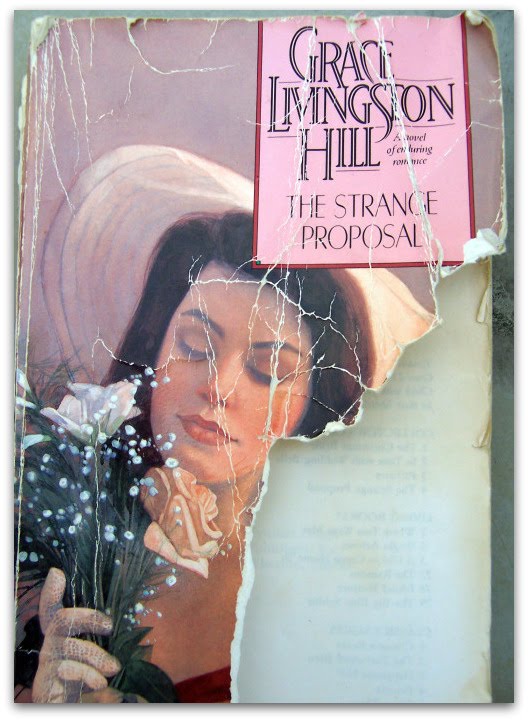
The Strange Proposal (1935). The Strange Proposal has one of the strongest heroines in Hilldom. Mary Elizabeth Wainwright is rich, John Saxon is not. He's religious, she's not. He's a struggling young doctor, she's a heiress. He has two feeble parents (who who own a struggling orange grove in Florida!), she has one hearty father (who is a wealthy businessman in Boston). What makes this one fun is the fact that the guy proposes to her the very first time they meet...when he thinks she's someone else.
rity...or something. He obtains the encrypted message from the bad guys, but then has to run for his life. He runs right into a wedding and is mistaken for the groom (whom no one has seen for years). He 'marries' Celia - who didn't want to marry the real groom - she was being coerced. The two fall in love while being chased back to Washington D. C..
The Strange Proposal (1935). The Strange Proposal has one of the strongest heroines in Hilldom. Mary Elizabeth Wainwright is rich, John Saxon is not. He's religious, she's not. He's a struggling young doctor, she's a heiress. He has two feeble parents (who who own a struggling orange grove in Florida!), she has one hearty father (who is a wealthy businessman in Boston). What makes this one fun is the fact that the guy proposes to her the very first time they meet...when he thinks she's someone else.
Friday, August 13, 2010
Life After Betty - Grace Livingston Hill: Part One
Betty Keira and I decided to do a couple of posts each about Grace Livingston Hill. So here goes...Grace Livingston Hill (1865-1947) was born on April 16, 1865 to a Presbyterian Minister, Charles and a published author, Marcia, in Wellsville, New York. She was an early 20th century "Christian Romance" novelist. She was immensely popular in the time that she wrote, contributing hundreds of novels and short stories during her lifetime. Her characters were most often young female ingénues, frequently strong Christian women or those who become so within the confines of the story. -Wikipedia
Neither Betty Keira or I are particularly fond of "Christian Romance", but we make an exception for the occasional GLH. Grace did have the tendency to be fairly heavy-handed with the religious elements within her stories...which sometimes weighs down the storyline too much - to the point of dreariness, but when she does it with a light hand, her books can be quite fun. Betty and Grace both specialized in clean romances, but there are vast differences in themes and characters:
*GLH heroines are most often described in terms of "dainty, wraith-like and delicate" no 'Olivia's' allowed.
*Instead of being hearty trencherwomen like Betty's girls, GLH girls live on things like one lettuce leaf, and half a radish, although they are generally capable of cooking for the menfolk.
*Favorite hair color? Nary a mouse to be found. GLH heroines are nearly all ethereal blondes.
*Parents, in GLH, if living, are generally feeble and aged, in much need of tender care because they are liable to pop off at any time - making Neel's parents seem quite robust in comparison.
*GLH did not countenance drinking, dancing, smoking, make-up, gambling, divorces...
*Fun can be had in healthy sports such as swimming, tennis, bicycle riding, horse riding and visits to the oceanside for convalescent parents.
*Heroes have vague sort of careers...something to do with "Banking", something to do with "The Government," etc...generally the heroes are described as being "very good in their line"- I find myself pretty much left in the dark as to what that "line" might be.
*Plots are often highly melodramatic (think 'silent movies')...but considering when Grace started writing, they were probably mainstream. I find that when reading GLH it's best to act like it was written 'tongue in cheek', and simply enjoy the anachronisms, which fly with merry abandon.
Exit Betty - 1919 (available for free download here).
First of all, the name....Exit Betty! This was the first GLH book that I ever read. Betty collapses at her wedding when she sees that the bridegroom is not who she expected...it's her evil stepbrother, Herbert! She escapes out a side door and runs into Jane (who would have been a friendly Cockney if this had been written by LaNeels). Jane takes her in, dyes Betty's golden hair and ships her off to her hometown in Ohio. If you can get past the character of Betty (who makes the most wispy of Aramintas look positively 'butch') - who is about as dumb as a post, there's plenty of inadvertently campy fun to be had.
First of all, the name....Exit Betty! This was the first GLH book that I ever read. Betty collapses at her wedding when she sees that the bridegroom is not who she expected...it's her evil stepbrother, Herbert! She escapes out a side door and runs into Jane (who would have been a friendly Cockney if this had been written by LaNeels). Jane takes her in, dyes Betty's golden hair and ships her off to her hometown in Ohio. If you can get past the character of Betty (who makes the most wispy of Aramintas look positively 'butch') - who is about as dumb as a post, there's plenty of inadvertently campy fun to be had.For more free campy fun try:
The Man of the Desert - 1914. (also available as free download). The heroine is carried off by a runaway horse after she slaps a divorced man who tried to kiss her!
Friday, May 14, 2010
Mira Stables
My local library doesn't admit to carrying any Mira Stables books. None. I ended up buying a couple of used ones on Amazon, and another couple of used ones from my local creepy used book store. The creepy book store is cheaper than Amazon, but it's a last resort type of place. Books are stacked all over the place - I'm pretty sure the place is a major fire hazard. That's part of the reason I never stay long...that and the fact that it tends to be quite unorganized and dirty. Not racy dirty, just dirty.
High Garth - Betty Magdalen suggested this one, and I heartily agree, it's a winner. Hard working heroine, harder working hero, plucky little half-brother, spelunking, Yorkshire and rich relatives. I liked that Ann never wanted to take her stepfather's name (Papa Fortune), partly because she would then be know as "Miss Fortune" - how awesome is that?
The Golden Barrier - Hard working hero, Dermot is trying to make a go of his family's estate...he is a cousin or nephew, anyway, he didn't inherit a title but he does have the house and grounds. Both of which have been sadly neglected. Girl from the neighborhood is the daughter of a wealthy Cit. The "golden barrier" is the fact that she is rich and he is not. Fortunately the barrier is overcome in the end. I love the part where Katherine sneaks over to his house every day and mends the tapestry - just for something to do.
Summer at Dorne - this one was much more "dramatic" than the other three books. Chantal's cousin is trying to force her into marrying him. He spreads rumors that she is insane, he has people that could help her (like her lawyer) killed, and he withholds food from her. When Chantal runs away, she hits her head and falls into a pool. Upon awakening, she finds that she's NAKED under a blanket. Hello, that would be our hero who has stripped her. He doesn't like her though - she's a girl and he doesn't like girls (a girl was responsible for his beloved older brother being crippled and confined to a wheelchair). Except that he does start to like, then love her. The cousin eventually finds her (in Scotland), has her abducted and then plans to spend a week raping her so as to force her into marriage. Yes, I just typed the "R" word. He doesn't succeed, in fact, he comes to a sticky end through his own rashness. It sounds exciting...but I just couldn't like the main characters enough. He's a tortured artist, she's been a bit "fast" in London...I dunno, they just didn't work for me.
The Swynden Necklace - most of the action takes place in and around Bath. Honor is bequeathed a fabulous diamond necklace, and a townhouse in Bath (but not much else). Her aunt wants her to go to Bath and have some fun. Her mom wants her to sell the necklace so that little bro. Percy can have a proper education. Auntie wins out (after all, they can sell the necklace later). Happily ever after is achieved with the help of Auntie (who proves herself quite a conspirator), Honor marries the man she loves (in spite of her mother)...and the man turns out to be not who she thought he was!
Friday, May 7, 2010
Hey There, Georgie Girl! (Part III)
I really, really meant it when I said that my library has a lot of Georgette Heyer novels. Really. Arabella. I adored the details that went into making over her mother's old clothe
s into new dresses for Arabella to wear to London (I wonder if they would smell musty or like mothballs?). On her way to London, the lovely Arabella takes temporary refuge in Mr. Beauvaris' house while waiting for the carriage to get fixed. He takes a fancy to her and his attentions make her the toast of the season...especially since eveyone but Mr. Beauvaris thinks she is a great heiress. She is not - she is a humble vicar's daughter - with a strong sense of justice. The scenes where she rescues a chimney sweep, rescues a mongrel, and wants to rescue a lass named "Leaky Peg" were all fun. (I would buy this one)
s into new dresses for Arabella to wear to London (I wonder if they would smell musty or like mothballs?). On her way to London, the lovely Arabella takes temporary refuge in Mr. Beauvaris' house while waiting for the carriage to get fixed. He takes a fancy to her and his attentions make her the toast of the season...especially since eveyone but Mr. Beauvaris thinks she is a great heiress. She is not - she is a humble vicar's daughter - with a strong sense of justice. The scenes where she rescues a chimney sweep, rescues a mongrel, and wants to rescue a lass named "Leaky Peg" were all fun. (I would buy this one) The
Convenient Marriage. After a very promising beginning, this book flounders badly. I can overlook heavy eyebrows. I can overlook a stuttering heroine (although it does get a bit tiring), I can sort of overlook a seventeen year old girl marrying a thirty five year old man. I can't overlook him having a mistress - especially after marriage. I am also not very amused by the seventeen year old bride's predilection for gambling. Did I mention that her nickname is Horry? (If you want to read this, check it out from the library)
Convenient Marriage. After a very promising beginning, this book flounders badly. I can overlook heavy eyebrows. I can overlook a stuttering heroine (although it does get a bit tiring), I can sort of overlook a seventeen year old girl marrying a thirty five year old man. I can't overlook him having a mistress - especially after marriage. I am also not very amused by the seventeen year old bride's predilection for gambling. Did I mention that her nickname is Horry? (If you want to read this, check it out from the library) The Unknown Ajax. Adventure, smugglers, ghost stories, hidden passageways
. The hero's name is Hugo - not Ajax - however, he is referred to as Ajax many times throughout the book - most often facetiously. Hugo's uncle and cousin have recently died in a boating accident - which now means that Hugo,aka"the weaver's brat", is an unwilling heir to Lord Darracott. The entire family resent his existence - even his good looking cousin Anthea, who has been told by Lord D. that he wants her to marry to boy. Hugo is fun - he pretends to be a poor yokel...when in reality he's practically a millionaire (is mother was no weaver - she was only daughter to a man who owned weaving mills) and does not need to be dependent upon a capricious grandfather. He also happened to have a good education (Harrow) and spent 10 years as a military officer. (I would buy this one at the thrift store!)
. The hero's name is Hugo - not Ajax - however, he is referred to as Ajax many times throughout the book - most often facetiously. Hugo's uncle and cousin have recently died in a boating accident - which now means that Hugo,aka"the weaver's brat", is an unwilling heir to Lord Darracott. The entire family resent his existence - even his good looking cousin Anthea, who has been told by Lord D. that he wants her to marry to boy. Hugo is fun - he pretends to be a poor yokel...when in reality he's practically a millionaire (is mother was no weaver - she was only daughter to a man who owned weaving mills) and does not need to be dependent upon a capricious grandfather. He also happened to have a good education (Harrow) and spent 10 years as a military officer. (I would buy this one at the thrift store!)Blac
k Sheep. When an impecunious fortune hunter goes after Abigail's niece, his black sheep Uncle Miles deftly scotches his schemes...and wins the hand of Abigail in the process. I love the ending of this book. Miles says, "My dear girl, you don't consent to an abduction! You consent to an elopement, and I knew you wouldn't do that." (Thrift store..yes. Full price. No.)
k Sheep. When an impecunious fortune hunter goes after Abigail's niece, his black sheep Uncle Miles deftly scotches his schemes...and wins the hand of Abigail in the process. I love the ending of this book. Miles says, "My dear girl, you don't consent to an abduction! You consent to an elopement, and I knew you wouldn't do that." (Thrift store..yes. Full price. No.)A Civil Contract. I stayed up until 1:30am reading this (I am generally asleep b
y 10pm or if I'm really really staying up late, 11pm). This may not be a Heyer book with universal appeal, but I really enjoyed it. Adam marries Jenny, only daughter of a very rich Cit, so that he can save the family estates. Jenny marries Adam because her father wants her to have a title. Okay, she really marries him because it's the only thing she can do for him. Jenny is plain, plump (someone says that she'll be fat by 40), no fashion sense, prosaic, and did I say plain? I'm not picturing a Betty Neels plain girl (with beautiful eyes), but really a plain, slightly chunky girl. Adam is recovering from being in love with the beautiful, ethereal, romantic Julia...who doesn't help matters in the least by swooning over him at awkward moments. (I would definitely buy this book - but I wouldn't be offended if you just check it out from your local library).
y 10pm or if I'm really really staying up late, 11pm). This may not be a Heyer book with universal appeal, but I really enjoyed it. Adam marries Jenny, only daughter of a very rich Cit, so that he can save the family estates. Jenny marries Adam because her father wants her to have a title. Okay, she really marries him because it's the only thing she can do for him. Jenny is plain, plump (someone says that she'll be fat by 40), no fashion sense, prosaic, and did I say plain? I'm not picturing a Betty Neels plain girl (with beautiful eyes), but really a plain, slightly chunky girl. Adam is recovering from being in love with the beautiful, ethereal, romantic Julia...who doesn't help matters in the least by swooning over him at awkward moments. (I would definitely buy this book - but I wouldn't be offended if you just check it out from your local library). Fred
erica. This book definitely gives The Grand Sophy a run for its money (I might even like it a tiny bit more). Frederica has brought her 3 younger siblings to London so that her beautiful 19 year old sister Charis can have the opportunity of contracting an eligible marriage. She applies to a distant relation - Lord Alverstoke for help in presenting her sister. He agrees...but really only does so because he knows it will make his own sisters mad - they also have girls that are "coming out" - and he knows that Charis will put them in the shade. I'm not sure which part of the book I enjoyed more - his lordship falling in love, or little brother Felix's scrapes. (I would buy this one...and I might even pay retail, which is saying a lot)
erica. This book definitely gives The Grand Sophy a run for its money (I might even like it a tiny bit more). Frederica has brought her 3 younger siblings to London so that her beautiful 19 year old sister Charis can have the opportunity of contracting an eligible marriage. She applies to a distant relation - Lord Alverstoke for help in presenting her sister. He agrees...but really only does so because he knows it will make his own sisters mad - they also have girls that are "coming out" - and he knows that Charis will put them in the shade. I'm not sure which part of the book I enjoyed more - his lordship falling in love, or little brother Felix's scrapes. (I would buy this one...and I might even pay retail, which is saying a lot) Friday, April 30, 2010
Hey There, Georgie Girl! (Part II)

More books by Georgette Heyer (I told you my library had a ton of them!):
Charity
Girl. At first I thought this one was going to be just like Sprig Muslin...foolish young girl runs away and is picked up by handsome eligible young man and is taken to an old girl-friend's house. Much of the book is taken up with the hero dashing about the country trying to find the young girl's missing grandfather. It's an fine read, but I wouldn't put it at the top of my Heyer reading list. (I would buy it at a thrift store, otherwise, check it out from the library)
Girl. At first I thought this one was going to be just like Sprig Muslin...foolish young girl runs away and is picked up by handsome eligible young man and is taken to an old girl-friend's house. Much of the book is taken up with the hero dashing about the country trying to find the young girl's missing grandfather. It's an fine read, but I wouldn't put it at the top of my Heyer reading list. (I would buy it at a thrift store, otherwise, check it out from the library)Faro's Daughter. On one hand, I sort of have to love a book w
herein the heroine has the hero kidnapped and locked in the cellar. Some sort of awesome! On the other hand, I never really connected with the gambling in the story. Deb, the heroine, is a bit more worldly than most of Heyer's heroines that I have encountered so far - but then, she does work in her aunt's gambling establishment. Deb is also quite dauntless...she doesn't blink at losing 600 pounds to the hero while playing picquet with the hero. (I wouldn't mind reading this one again, library check out.)
herein the heroine has the hero kidnapped and locked in the cellar. Some sort of awesome! On the other hand, I never really connected with the gambling in the story. Deb, the heroine, is a bit more worldly than most of Heyer's heroines that I have encountered so far - but then, she does work in her aunt's gambling establishment. Deb is also quite dauntless...she doesn't blink at losing 600 pounds to the hero while playing picquet with the hero. (I wouldn't mind reading this one again, library check out.) The T
oll-Gate. Murder, mystery, more murder, midnight marriage, love at first sight. This is a story that's more about the hero than a heroine. Captain John Staples...a lovely tall drink of water. He finds a young, frightened boy alone one night at a toll gatehouse and sticks around to help - and gets caught up in a mystery. John manages to fall in love at first sight - and is a little dispairing of getting the girl to agree to marry him - until her grandfather sort of forces a surprise wedding over his own deathbed. You go grandpa! (buy it from the thrift store...or library)
These Old Shades. I have already talked about this one once: "Delightful stor
y, fun characters. I'm not usually sold by Hero/Heroine with 20 year age differences, but Miss Heyer made it completely plausible. She also managed to make me believe that the "reformed rake" was truly reformed...and that's saying something." Lot's of fun, and if you don't mind men tottering around on high heels, then you should love this. (I would buy this one - partly due to the fact that it's a prequel to Devil's Cub)
oll-Gate. Murder, mystery, more murder, midnight marriage, love at first sight. This is a story that's more about the hero than a heroine. Captain John Staples...a lovely tall drink of water. He finds a young, frightened boy alone one night at a toll gatehouse and sticks around to help - and gets caught up in a mystery. John manages to fall in love at first sight - and is a little dispairing of getting the girl to agree to marry him - until her grandfather sort of forces a surprise wedding over his own deathbed. You go grandpa! (buy it from the thrift store...or library)These Old Shades. I have already talked about this one once: "Delightful stor
y, fun characters. I'm not usually sold by Hero/Heroine with 20 year age differences, but Miss Heyer made it completely plausible. She also managed to make me believe that the "reformed rake" was truly reformed...and that's saying something." Lot's of fun, and if you don't mind men tottering around on high heels, then you should love this. (I would buy this one - partly due to the fact that it's a prequel to Devil's Cub)Devil's Cu
b. The Zombie Bride recommended this one, and I have to say, thank you, Rebekah. It is a sequel to These Old Shades - with the son of the main characters from that novel. I do love the heroine - who shoots the hero (in the arm) in order to make her point - her point being that she isn't "that" kind of girl. She also manages to stop a sword fight - which earns her a slight wound to her shoulder and a ripped bodice. Two thumbs up. (I would buy this one!)
b. The Zombie Bride recommended this one, and I have to say, thank you, Rebekah. It is a sequel to These Old Shades - with the son of the main characters from that novel. I do love the heroine - who shoots the hero (in the arm) in order to make her point - her point being that she isn't "that" kind of girl. She also manages to stop a sword fight - which earns her a slight wound to her shoulder and a ripped bodice. Two thumbs up. (I would buy this one!)Friday, April 23, 2010
Hey There, Georgie Girl! (Part I)
In our continuing series "Life After Betty" we here at The Uncrushable Jersey Dress have been recommended several different authors...I'd like to talk about one author today (with a special thanks to Betty Janet for getting me started on her). Georgette Heyer. My local library actually has a ton of Heyer books, and I was lucky enough to get a bunch of them. After reading Cotillion, I was intrigued. I liked the book quite a bit...but I wouldn't be found sittin' in a tree, K-I-S-S....I did like the way Heyer crafted most of the story...and for such a long frothy story, that was saying something. So in I dove. Since nearly everyone who recommended Heyer had a different favorite, I figured I'd just have to read what was available and make up my own mind.
The
Masqueraders. A boy disguised as a girl and a girl disguised as a boy...because their father told them to. They each manage to fall in love...but when a boy dressed as a girl falls in love with a girl, how is he to woo her? And when a girl dressed as a boy falls in love with a man...ditto. Quite the tangled web...which is all untangled by the happily ever afters. Delightful. (I would buy this one...)
Masqueraders. A boy disguised as a girl and a girl disguised as a boy...because their father told them to. They each manage to fall in love...but when a boy dressed as a girl falls in love with a girl, how is he to woo her? And when a girl dressed as a boy falls in love with a man...ditto. Quite the tangled web...which is all untangled by the happily ever afters. Delightful. (I would buy this one...)Sprig M
uslin. At first I didn't think I would like this book. A very respectable man is traveling on his way to propose to an old maidish woman whom he has known and liked for years. He ends up practically abducting a beautiful 16 year old run-a-way. For her own good. Most of the book involves him thwarting her escapes and countering her endless supply of lies...which at first were annoying, but then you just can't help but see how audacious and occasionally brilliant they are - even when they backfire.(I might buy this one...)
uslin. At first I didn't think I would like this book. A very respectable man is traveling on his way to propose to an old maidish woman whom he has known and liked for years. He ends up practically abducting a beautiful 16 year old run-a-way. For her own good. Most of the book involves him thwarting her escapes and countering her endless supply of lies...which at first were annoying, but then you just can't help but see how audacious and occasionally brilliant they are - even when they backfire.(I might buy this one...)The R
eluctant Widow. Meeting and marrying a man on his deathbed? Where's the fun in that? This book just missed being enchanting. The heroine is a bit too whiny for my taste (although, in all fairness, she had plenty to grumble about). Hidden staircases, murder, manslaughter, spies, lost military secrets - these all add up to a more serious story. Which is okay, just not one of my favorites. (Library check-out only).
eluctant Widow. Meeting and marrying a man on his deathbed? Where's the fun in that? This book just missed being enchanting. The heroine is a bit too whiny for my taste (although, in all fairness, she had plenty to grumble about). Hidden staircases, murder, manslaughter, spies, lost military secrets - these all add up to a more serious story. Which is okay, just not one of my favorites. (Library check-out only).Sylvester. T
he Duke of Salford may as well be Mr. Darcy. He is very proud and also very correct in his manners, to everyone. He decides it's time that he marries so that he may...*ahem*...beget an heir to his awesomeness. He tells his mother that he has looked over the eligible bachelorettes and narrowed the choice down to five. He plans on choosing one - but he doesn't have any particular preferences...she suggests another girl (Phoebe) - and so he goes off to meet and perhaps marry her. Trials and troubles ensue...he finally begins to see that perhaps he might be a tad proud, she begins to see....I love that his mother is the one who pretty much proposes for him. (I would buy it in a minute, if I found it at a thrift store)
he Duke of Salford may as well be Mr. Darcy. He is very proud and also very correct in his manners, to everyone. He decides it's time that he marries so that he may...*ahem*...beget an heir to his awesomeness. He tells his mother that he has looked over the eligible bachelorettes and narrowed the choice down to five. He plans on choosing one - but he doesn't have any particular preferences...she suggests another girl (Phoebe) - and so he goes off to meet and perhaps marry her. Trials and troubles ensue...he finally begins to see that perhaps he might be a tad proud, she begins to see....I love that his mother is the one who pretty much proposes for him. (I would buy it in a minute, if I found it at a thrift store)The Grand Sop
hy. Sophy is a force of nature. If I had to describe her I would have to say that she strongly reminds me of Barbara Streisand in Hello Dolly. Only younger. When her father goes off to Brazil on a diplomatic mission, she stays with her cousins in London. And she fixes everyone. She has great dash and verve - this is one book that I would describe as "a romp". Quite, quite fun. So far, it's my favorite. Read it. Now. (I will definitely be buying this one...I can see us becoming quite good friends).
hy. Sophy is a force of nature. If I had to describe her I would have to say that she strongly reminds me of Barbara Streisand in Hello Dolly. Only younger. When her father goes off to Brazil on a diplomatic mission, she stays with her cousins in London. And she fixes everyone. She has great dash and verve - this is one book that I would describe as "a romp". Quite, quite fun. So far, it's my favorite. Read it. Now. (I will definitely be buying this one...I can see us becoming quite good friends).Saturday, March 20, 2010
Betty and the Real World
I love it when The Venerable Neels mentions real, actual verifiable objects or events in her books. She's wonderful when it comes to churches and museums, every reputable eatery from London to Harwich and freeway loo stops. More rare are other pop culture mentions that seem to tether The Betty to reality like rope anchors hanging from a Macy's Thanksgiving Day parade float.

In Grasp a Nettle we have at least two:
Mr. Sharif's bower of love.

In Grasp a Nettle we have at least two:
- Jenny is reading to young baron Oliver--...she opened Winnie the Pooh. "Shall I start reading?" "Yes, please." I think The August Betty had to have said these words out loud at some point in her life, "I'm rumbly in my tumbly", "Oh bother" and "I'm just a little black raincloud." On a side note, when I wiki-ed (yes, it can too be a word) A. A. Milne it related that he was a critic of P.G. Wodehouse--"captured at his country home in France by the Nazis and imprisoned for a year. Wodehouse made radio broadcasts about his internment, which were broadcast from Berlin. Although the lighthearted broadcasts made fun of the Germans, Milne accused Wodehouse of committing an act of near treason by cooperating with his country's enemy." Well, my lands.
- While on the cruise they come into Puerto de los Marmoles. ...he pointed out anything which he considered she might be interested in--dragon trees, the house built by Omar Sharif when he had filmed on the island some years previously... When I see pictures of Omar Sharif I can't help but think of his tooth-gap gesticulating with winning charm in Funny Girl. And my heart sings, "Nicky Arnstein, Nicky Arnstein, Nicky Arnstein..."
Mr. Sharif's bower of love.In The Gemel Ring we've got at least one:
- Mr. and Mrs. Boekerchek take Charity to see La Boheme which she watches with her eyes closed as the Mimi was "a strapping size twenty, exuding splendid health with every note." I do love me some opera but wonder why it is that composers and librettists so often have their sopranos die of consumption--a disease most calculated to get in the way of the singing, no?
Subscribe to:
Posts (Atom)